Article
Trinity Church: Top U.S. Landmark Near Newbury Guest House
A Back Bay “did you know” worth the stroll
In Boston, the best surprises aren’t always hidden, they’re simply a few blocks away, waiting for you to look up. Here’s one we love sharing: Trinity Church, in Copley Square, is recognized as one of the ten most important buildings in America, a distinction attributed to the American Institute of Architects. And from Newbury Guest House, it’s not a cross-city excursion. It’s the kind of walk you do with coffee in hand, in shoes you actually like.
If you’re staying at Newbury Guest House, you’re already positioned for Boston’s greatest “walking city” experiences, shopping, dining, brownstones, and the architectural details that make Back Bay feel like a living museum. Our own neighborhood guide notes that we’re about a five-minute walk from Copley Square, and that includes the “famous architectural jewels like Trinity Church.”
From Newbury Guest House to Trinity Church in minutes
Start at Newbury Guest House, step onto Newbury Street, and follow the natural gravity of Back Bay toward Copley Square. The route feels like a slow reveal: rows of 19th-century brownstones, storefront windows that deserve a pause, that crisp “Boston-in-motion” energy—equal parts polished and lived-in. Newbury Guest House sits at 261 Newbury Street, right in the heart of the neighborhood, which is exactly why so many guests love exploring without a car.
A few minutes later, you arrive at Trinity Church, set prominently on Copley Square, surrounded by streets so that every side of the building has a chance to make an impression. It’s a location that rewards lingerers: stand back, watch the city move, and let your eyes travel across the stone, the arches, the tower.
And that’s the magic pairing: Newbury Guest House gives you an elegant home base on Newbury Street, and Trinity Church gives you a true architectural landmark “just around the corner”, the kind of stop that instantly upgrades a weekend from nice trip to seriously memorable Boston.
Why Trinity Church ranks in America’s architectural top tier
You’ll often hear Trinity described with superlatives, and in this case, the sources back it up. Trinity Church’s own materials describe it as a National Historic Landmark and note that it’s recognized as one of the ten most important buildings in America by the American Institute of Architects.
For travelers who like a little more context (Boston Globe readers, we see you), Trinity’s history page adds a striking detail: in the late 19th century, it was voted the finest building in the United States by members of the architecture profession, and it later remained the only building from an original “top ten” list when the AIA held a similar competition in 1986.
That matters because this isn’t popularity-contest fluff. Trinity Church helped redirect American architecture. It’s not merely a beautiful church in a beautiful square; it’s a building that influenced how public buildings across the country would soon look and feel.
The building that gave America a new architectural language
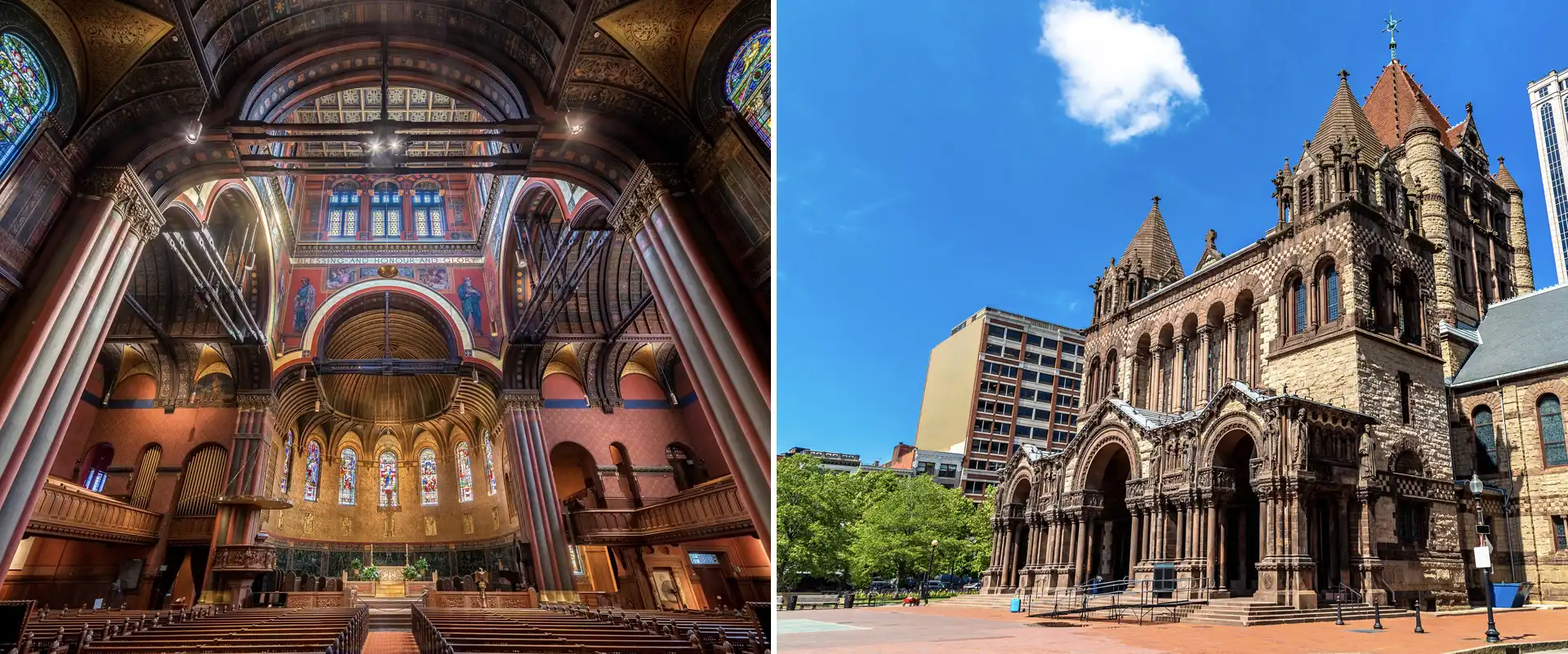
Trinity Church is closely tied to the architect Henry Hobson Richardson, so much so that the style it helped define is named for him: Richardsonian Romanesque. Trinity’s own architectural overview describes it as a celebrated example of that design approach, characterized by massive proportions, rounded arches, and rough, multi-colored stone.
One of the most dramatic features is the central tower, rising 211 feet above the crossing, an element the exterior audio tour calls out as the organizing axis of the building’s form and presence. When you see it in person, it makes intuitive sense: Trinity Church doesn’t just occupy the square; it anchors it.
The materials and color story are part of the spell. The audio tour describes the exterior walls as granite quarried in Dedham, Massachusetts, with brownstone trim (including brownstone framing around doors and windows) that punctuates the façade. It’s a palette that reads warm and substantial, even on a gray New England day.
For guests at Newbury Guest House, this is exactly the kind of nearby landmark that fits the Back Bay rhythm: you don’t need to schedule around it. You can simply decide, between breakfast and your first stop on Newbury Street, that today is a Trinity Church day.
Inside Trinity Church: murals, stained glass, and a “color church” vision
Trinity Church is known for its exterior presence, but the inside is where many visitors fall quiet. Trinity’s art and architecture page credits painter John La Farge and his team of American-born artists with creating the church’s interior decorative program, emphasizing how the decoration was designed to feel unified with the architecture.
Then there’s the stained glass, one of Trinity’s signature pleasures. The church notes that Trinity houses a significant collection of stained glass produced by nine different studios, with many windows installed between 1877 and 1888. The collection includes works associated with William Morris and Edward Burne-Jones, as well as stained glass masterpieces by John La Farge.
If you’re the kind of traveler who likes to know what’s happening behind the scenes, Trinity’s exterior audio tour also calls attention to the building’s remarkable interior program, pairing figurative stained-glass windows with La Farge’s large-scale mural work as a core part of why the building is so significant.
This is where Newbury Guest House and Trinity Church make an especially good match for a weekend itinerary: Newbury Guest House is rooted in Boston’s brownstone character and “European charm in a Colonial American setting,” and Trinity Church is a masterwork of the same city’s ambition, monumental, artistic, and unmistakably Boston.
An engineering feat beneath your feet: Back Bay’s filled land and 4,500 pilings
Back Bay wasn’t always “Back Bay” as we know it today. Trinity’s audio tour explains that the area was originally a tidal estuary, and that beginning in the 1850s a 40-plus-year project filled the marsh to create over 450 acres of new land.
Here’s the detail that tends to stop people mid-sentence: because of the conditions of this filled land, many buildings from that era stand on wooden piles. The Trinity audio tour notes that there are approximately 4,500 pilings under Trinity Church alone.
That “timber piles + stable groundwater” reality isn’t merely trivia, it shaped how Trinity could be modernized, too. A 2002 Episcopal News Service release about Trinity’s renovation describes the drilling of six geothermal wells as part of a new energy system and notes that equilibrium matters in Back Bay precisely because many buildings are built on wooden pilings that require an unchanging water table.
And preservation work continued into the 21st century in a way that’s both practical and forward-looking: the Boston Preservation Alliance describes a major restoration and expansion spanning 2002 to 2006, including installing an environmentally-friendly geothermal heating and cooling system, restoring exterior stone and mortar, and expanding the undercroft to add program space, done while the church remained open and operational.
How to experience Trinity Church from Newbury Guest House like a local
The best way to visit Trinity Church is with just enough structure to notice what’s special—and enough flexibility to let the building lead.
A simple approach: walk from Newbury Guest House toward Copley Square, arrive a little earlier than you think you need to, and spend a few minutes outside first. One of the most memorable views in the square is the “conversation” between old and new: the Trinity audio tour points out how the glass tower across the street can reflect the church and help you see parts of the façade in a different way. (If you’re curious, this is the famous reflective neighbor at 200 Clarendon.)
Once inside, remember this isn’t a static monument. Trinity’s art and architecture page is explicit: Trinity Church is not a museum, it’s an active Episcopal parish and a sacred space of worship and service. At the same time, it welcomes visitors who want to learn about its art and architecture, noting that docent-led, audio, and self-guided tours are available.
And if you like a stat that tells you you’re in good company: Trinity’s history page notes that it welcomes more than 70,000 visitors each year, in addition to worshippers, proof that this is one of Boston’s most enduring “must-see” architectural experiences.
Afterward, return to Newbury Guest House the way locals do: unhurried, taking the long way if a window display or a café looks tempting. That’s the pleasure of staying on Newbury Street, your day doesn’t end when the sightseeing ends. It simply shifts into evening.
A final invitation
Whether you’re in town for a weekend away, a first Boston visit, or a “let’s pretend we live here” staycation, Trinity Church is one of those rare landmarks that feels both world-class and wonderfully close, an easy walk with major payoff. If you’re planning your next Boston trip, stay at Newbury Guest House, and make time to step into Trinity Church, one of America’s top-tier architectural treasures, just minutes from our front door. We’d love to welcome you to Newbury Guest House, and we hope you’ll visit Trinity Church while you’re here.