Article
The Ultimate Guide to Back Bay Boston for First-Time Visitors
The Back Bay land reclamation project began in 1857 and took 25 years to complete. A tripartite agreement between the Commonwealth of Massachusetts, the City of Boston, and private landowners authorized the filling of more than 450 acres of tidal flats, nearly doubling the size of the Boston peninsula. Gravel was transported 9 miles from Needham via a specially built railroad, running on a continuous schedule at peak filling periods. By most accounts, it ranked among the largest urban engineering projects in American history at the time.
The street plan, approved in 1856 by architect Arthur Gilman, established the alphabetical grid that still defines the neighborhood today: Arlington, Berkeley, Clarendon, Dartmouth, Exeter, Fairfield, Gloucester, Hereford. That deliberate sequence explains why Back Bay feels so easy to navigate compared to the rest of Boston, where streets follow centuries-old cow paths and colonial property lines. The grid was a feature, not an accident.
Why the historic district designation in Back Bay still matters today
In 1965, Back Bay received official historic district status, recognizing its unbroken Victorian streetscape as one of the most intact examples of 19th-century urban planning in the United States. The designation covers the Romanesque, Renaissance Revival, and brownstone architecture that lines every block. Because of this protected status, new construction and facade alterations face strict oversight, which is exactly why the neighborhood still looks the way it does. Walking through Back Bay today, you're largely seeing what residents saw in 1900, thanks to more than six decades of active preservation.
The landmarks worth anchoring your visit around Copley Square and its architectural centerpieces
Copley Square is the natural starting point for any first-time visit. It's free, open around the clock, and flanked by three of the most significant buildings in Boston. Trinity Church, completed in the 1870s in the Richardsonian Romanesque style, is open Wednesday through Saturday from 10 AM to 4:30 PM. Admission is $10 for adults and $8 for seniors, students, and Massachusetts residents; children under 14 enter free. Audio tours are available via QR code, and guided docent tours run at select times.
Directly across the square sits the Boston Public Library McKim Building, the second-largest public library in the United States. Entry is free, and hours run Monday through Saturday from 9 AM to 9 PM and Sunday from noon to 5 PM. The interior courtyards and Bates Hall reading room are worth seeing even if you're not borrowing anything. One detail that surprises most first-timers: the Copley Square plaza marks the finish line of the Boston Marathon.
The Boston Public Garden and Commonwealth Avenue Mall
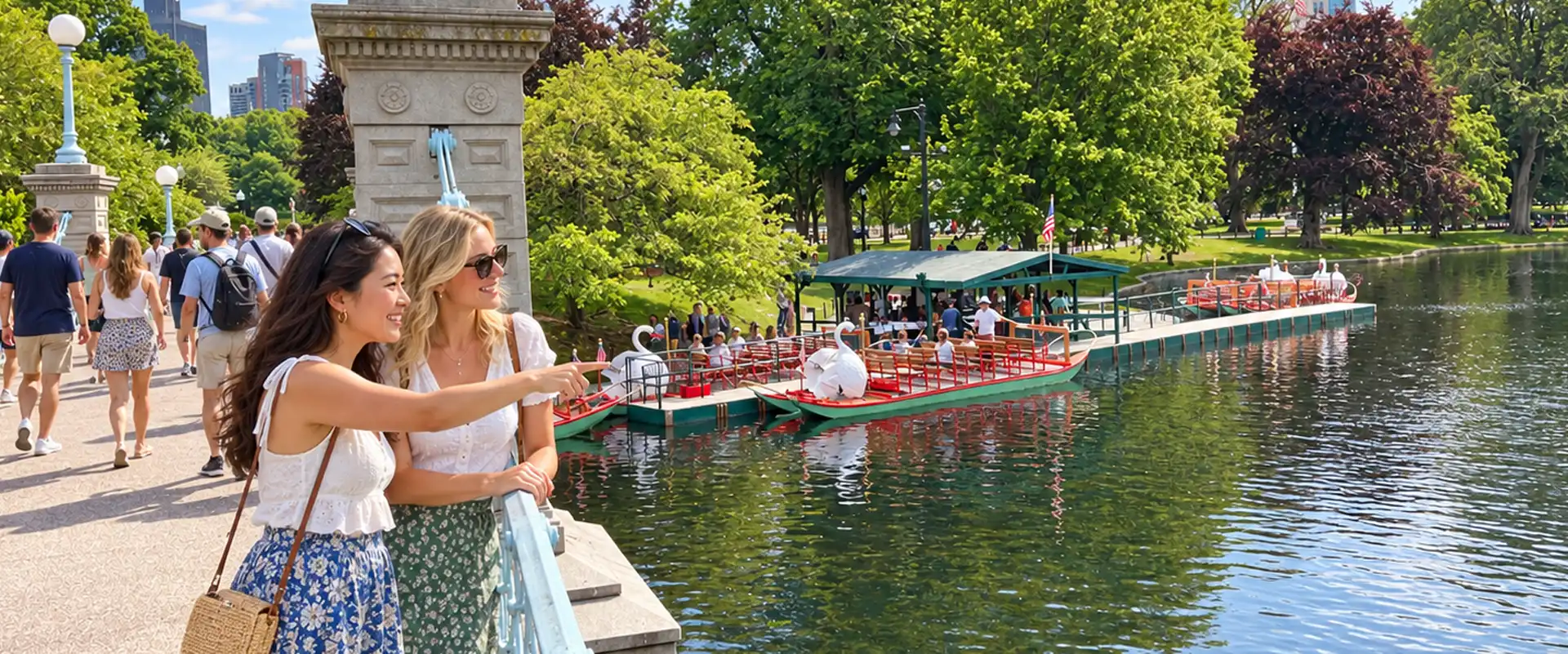
The Boston Public Garden is the first public botanical garden in the United States, established in 1837. The Swan Boats operate from mid-April through early September, with tickets running $4.75 for adults and $3.25 for children. (Prices may change, so check online for the latest). The Make Way for Ducklings sculpture near the Charles Street entrance is a perennial stop for families. From the Arlington Street end of Newbury Street, the Garden is a two-minute walk.
The Commonwealth Avenue Mall connects the Public Garden to Kenmore Square via a wide, tree-lined promenade. Walking it even once is worthwhile, not for any single landmark but for the architecture on either side. In fall, the elm canopy turns golden and the boulevard stands as one of the most beautiful urban walks in New England.
Prudential Center and views above the city
The View Boston Skywalk Observatory at the Prudential Center gives you the clearest sense of how Back Bay fits into the larger city. From above, the alphabetical grid is unmistakable, and the scale of the reclamation project becomes physically apparent. On cold or rainy days, the Prudential Center's skybridge connection to Copley Place makes it possible to move between major shopping and dining destinations without stepping outside.
Shopping on Newbury Street from end to end
How the street changes block by block
Newbury Street runs eight blocks from Arlington Street to Massachusetts Avenue, and the character shifts noticeably as you move west. The Arlington end is home to luxury flagships and hushed art galleries. By the time you reach the Gloucester and Hereford blocks, the vibe is entirely different: vintage stores, record shops, tattoo parlors, and the kind of coffee shops that don't take reservations. Walking the full length takes about 20 minutes at a casual pace.
The transition happens gradually enough that you feel it before you notice it. Around the Exeter to Fairfield blocks, prices drop and crowds thin slightly. The brownstone facades stay consistent throughout, which gives the street visual coherence even as the tenant mix changes completely. That contrast between the uniform architecture and the varied retail makes Newbury Street genuinely interesting to walk rather than just to shop.
Art galleries, boutiques, and what to look for
Newbury Street has housed art galleries alongside retail for decades, particularly between Arlington and Dartmouth. Many occupy upper floors of brownstones, easy to miss if you're only looking at street level. For anyone staying at Newbury Guest House , the street is literally outside the front door, which changes how you use it. Rather than a scheduled itinerary item, it becomes a daily backdrop: morning coffee on the way out, an evening browse on the way back in.
Where to eat and drink in Back Bay Budget and casual spots that are worth it
Dirty Water Dough (181 Newbury St.) sells pizza by the slice for around $3 to $4, making it one of the best value stops on the street. Greco at 264 Newbury handles wood-fired pizza for a few dollars more. Pavement Coffeehouse at 281 Dartmouth is the reliable choice for coffee and breakfast sandwiches before you start walking. None of these require reservations or advance planning.
Mid-range dining with patio atmosphere
Stephanie's on Newbury (190 Newbury) is the weekend brunch standout, known for its Bloody Mary bar and outdoor seating. Joe's on Newbury (181 Newbury) covers lobster rolls and clam chowder with one of the better people-watching patios on the block. Saltie Girl at 281 Dartmouth specializes in New England oysters and crudos, and earns a reservation for a relaxed dinner without the price pressure of a full splurge meal.
Splurge-worthy restaurants for a special occasion
The Capital Grille at 900 Boylston and Grill 23 & Bar at 161 Berkeley represent the go-to choices when the meal itself is the event. Both are serious steakhouses with strong wine programs. Contessa at the Newbury Hotel offers rooftop dining with skyline views, worth booking when the weather cooperates and you want the full Back Bay experience at altitude.
Getting to Back Bay and moving around once you're there
MBTA options that get you directly into the neighborhood
The Orange Line stops at Back Bay Station at 145 Dartmouth Street, with the Dartmouth Street exit being the most straightforward for most visitors. Four Commuter Rail lines also stop here: Providence/Stoughton, Franklin/Foxboro, Needham, and Framingham/Worcester. Amtrak service, including Acela, uses the same station. Back Bay Station has no dedicated MBTA parking, so drivers should plan for a commercial garage on Dartmouth or Clarendon.
For navigating within the neighborhood, the Green Line is more useful than the Orange Line. The Arlington, Copley, and Hynes Convention Center stops sit along Boylston Street and put you within easy walking distance of every major landmark. Ride-share dropoff works best at the station's North End entrance at 145 Dartmouth Street or along Columbus Avenue.
Why Back Bay rewards walkers more than drivers
The grid layout makes walking genuinely easy here. Back Bay Station to Copley Square is about five minutes on foot. Copley Square to the Public Garden adds another ten minutes. Newbury Street to the Prudential Center takes roughly eight minutes. These are not aggressive estimates: the neighborhood is compact, flat, and well-marked. A car adds parking costs and removes the street-level experience that makes Back Bay worth visiting in the first place.
Making the most of your Back Bay visit
Back Bay suits a wide range of visitors. History enthusiasts, serious shoppers, and people who simply want a beautiful place to walk without a rigid plan all find something worth their time here. Keep it practical: use the Green Line for transit within the neighborhood and treat Copley Square as your geographic center point.
The best version of a Back Bay visit is one where you slow down enough to notice the details: the carved brownstone lintels, the gallery windows on upper floors, the way the elms along Commonwealth Avenue filter afternoon light. That experience is available to anyone who visits, but it's most accessible to those already staying here. Reserve your room at Newbury Guest House directly and wake up already inside the neighborhood.